
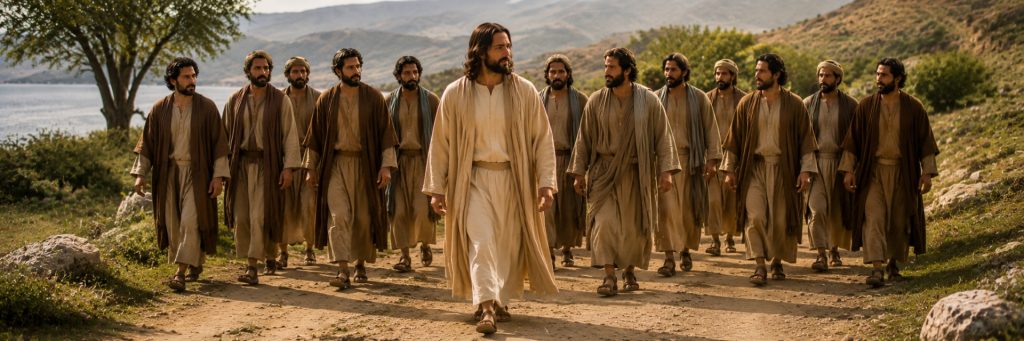
In this devotion, we’ll take a look at the twelve disciples and where they came from. From a human perspective, some of these men might seem like unexpected choices.
They weren’t religious celebrities or powerful leaders. They were ordinary men whom Jesus chose for an extraordinary purpose.
These are the twelve he chose: Simon (whom he named Peter), James and John (the sons of Zebedee, but Jesus nicknamed them “Sons of Thunder”), Andrew, Philip, Bartholomew, Matthew, Thomas, James (son of Alphaeus), Thaddaeus, Simon (the zealot), Judas Iscariot (who later betrayed him). Mark 3:16–19
Peter and his brother Andrew were fishermen, as were James and John. Jesus called these four men away from their nets to follow Him.
Philip came from Bethsaida, the same hometown as Peter and Andrew. Bartholomew is generally identified with Nathanael, whom we meet in John’s Gospel.
Matthew was a tax collector. That occupation would have made him especially unpopular among his fellow Jews because tax collectors worked within the Roman taxation system and had a reputation for dishonesty.
Thomas is best remembered for his doubts concerning the resurrection of Jesus, but there was more to Thomas than his doubts. At one point, when Jesus decided to return to Judea despite the danger, Thomas told the other disciples, “Let’s go, too—and die with Jesus.” He could demonstrate courage and loyalty.
We know very little from Scripture about James, son of Alphaeus, or Thaddaeus.
Simon was known as the Zealot. Whatever Simon’s precise involvement with the Zealot movement may have been, that description certainly distinguishes him from Matthew the tax collector.
Then there was Judas Iscariot, the disciple who eventually betrayed Jesus for thirty pieces of silver.
What a diverse group of men!
Why Jesus’ Unexpected Choices Made Good Disciples
I don’t believe Jesus arbitrarily chose the first twelve guys He saw. He had a reason and a purpose for choosing each of them. In the same way, He has a purpose for each of us.
Several of the men Jesus chose were fishermen. When He called Peter and Andrew, He used something they already understood to describe the work He was calling them to do.
Free eBook

One day as Jesus was walking along the shore of the Sea of Galilee, he saw two brothers—Simon, also called Peter, and Andrew—throwing a net into the water, for they fished for a living. Jesus called out to them, “Come, follow me, and I will show you how to fish for people!” Matthew 4:18–19
They understood fishing. They knew about casting nets, working patiently, and bringing in a catch. Jesus took something familiar to them and used it to describe something much greater.
The Lord still uses people’s backgrounds, experiences, abilities, and training today.
Maybe you don’t throw a net into the water for a living. But with the complexity of today’s church and its ministries, God can use what you know and what you have experienced to reach others for Christ.
You can become a fisher of people right where God has placed you.

Two Very Different Kinds of People
Think about Matthew and Simon the Zealot.
Matthew collected taxes within a system controlled by Rome. Simon was identified as a Zealot. From a human standpoint, these aren’t two men we would necessarily expect to find serving together.
But Jesus called both of them.
That’s an important lesson for the church. Jesus doesn’t call everyone from the same background. He brings together people with different personalities, occupations, experiences, and histories and makes them part of His work.
Where have you come from?
Maybe you were raised with a silver spoon in your mouth. Maybe you came from the slums of the inner city. More likely, you fall somewhere in between.
Whatever your background, God can use your experiences to help you understand and minister to people others may have difficulty reaching.
Matthew is a particularly good example. Tax collectors weren’t well respected. Yet when Jesus called him, Matthew got up and followed Him.
Following Jesus meant leaving his old life behind.
Sometimes following Christ will affect our relationships too. There may be people who don’t understand our commitment to Him. There may even be people who reject us because of it.
The question is whether we are willing to follow Jesus regardless of the cost.

Then There Was Thomas
Thomas has carried the label “Doubting Thomas” for centuries. Yet two wonderful statements from Jesus came in response to Thomas’s questions and doubts.
When Jesus told His disciples that He was going away, Thomas spoke up.
“No, we don’t know, Lord,” Thomas said. “We have no idea where you are going, so how can we know the way?” Jesus told him, “I am the way, the truth, and the life. No one can come to the Father except through me.” John 14:5–6
Later, Thomas doubted the other disciples when they told him they had seen Jesus alive after His crucifixion. Eight days later, Thomas saw the risen Lord for himself.
“My Lord and my God!” Thomas exclaimed. Then Jesus told him, “You believe because you have seen me. Blessed are those who believe without seeing me.” John 20:28–29
That’s us!
We haven’t physically stood before the risen Jesus as Thomas did, yet we have placed our faith in Him. Jesus said that those who believe without seeing Him are blessed.
Thomas reminds us that Jesus can work with people who have questions. Thomas’s doubts didn’t have the final word. Faith did.

What We Can Learn From Judas
Judas is different from the others because his story ended tragically.
He walked with Jesus, heard His teaching, and witnessed His miracles. He was included among the twelve. Yet eventually Judas betrayed Jesus for thirty pieces of silver.
There is a sobering lesson in his life.
Being around Jesus’ followers isn’t the same thing as having our hearts completely surrendered to Jesus. We must continually examine our motives and seek to remain in the center of God’s will.
Judas also teaches us something about what to do when we fail.
After betraying Jesus, Judas was filled with remorse, but instead of turning to the Lord for mercy and forgiveness, he took matters into his own hands and ended his life.
The Disciples Were Anything but Perfect
Peter also failed Jesus. Peter denied three times that he even knew Him. But Peter’s failure wasn’t the end of his story. He returned to the Lord and was restored.
When you fail—and there will be times when you do—don’t run away from Jesus. Run to Him.
Ask for His forgiveness. Allow Him to change your heart and restore you.
The twelve disciples remind us that Jesus uses ordinary and imperfect people. These men came from different backgrounds. They had different personalities. And they had strengths, weaknesses, questions, and failures.
And except for Judas, these unlikely men allowed Jesus to transform their lives and use them to help change the world.
Lord, thank You that You don’t limit Your work to people who seem important or impressive. Thank You for using ordinary people.
Help me surrender my abilities, experiences, weaknesses, and entire life to You. When I fail, remind me to run to You instead of away from You.
Use my life for Your purposes and help me faithfully follow Jesus. In His name, amen.
Check out these related posts on discipleship.
To receive each new devotional post delivered to your inbox, subscribe below by giving us your first name and email address